
Beta-Glucans Explained: Why They Matter in Medicinal Mushrooms

Understanding One of Nature’s Most Interesting Mushroom Compounds
If you’ve ever looked closely at a medicinal mushroom supplement label, you’ve probably noticed the term beta-glucans. Many high-quality mushroom products list a beta-glucan percentage, while others make bold claims about their importance. But what exactly are beta-glucans, and why do they appear on supplement labels?
For many people, the term sounds scientific and complicated. In reality, the concept is much easier to understand than you might think.
This guide explains what beta-glucans are, where they’re found, why they’re measured, and how understanding them can help you make more informed decisions when choosing medicinal mushroom products.
Whether you’re interested in Cordyceps, Lion’s Mane, Reishi, Turkey Tail, or other functional mushrooms, learning about beta-glucans is another step toward becoming an informed consumer.

What Are Beta-Glucans?
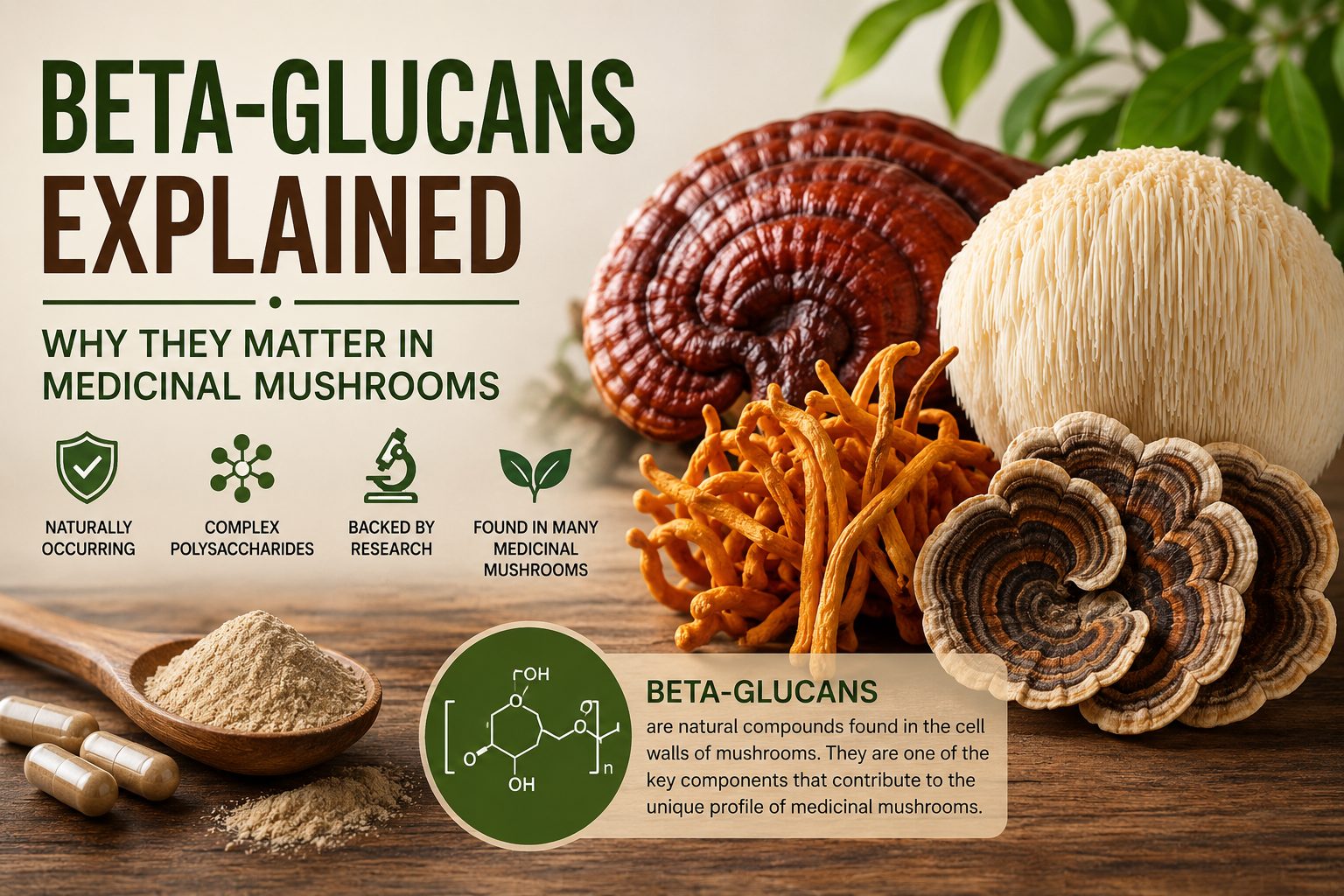
Beta-glucans are naturally occurring complex carbohydrates known as polysaccharides. They are found in the cell walls of many living organisms, including:
- Medicinal mushrooms
- Baker’s yeast
- Oats
- Barley
- Some algae
Although beta-glucans occur in several different sources, the structure of mushroom beta-glucans is different from the beta-glucans found in cereal grains such as oats and barley.
Inside a mushroom, beta-glucans form part of the rigid cell wall, helping provide structure and support. Every mushroom cell contains many different naturally occurring compounds, and beta-glucans are one important component of that structure.
Why Are Beta-Glucans Important?
When people first hear about beta-glucans, they often assume they are a special ingredient added during manufacturing.
They are not.
Beta-glucans are naturally present in mushrooms.
Because they occur naturally within the fungal cell wall, many manufacturers choose to measure and report beta-glucan content as one indicator of product composition and quality.
Rather than focusing on marketing claims, consumers can use beta-glucan information as one piece of the overall picture when comparing mushroom supplements.
However, beta-glucan content should never be viewed in isolation. A quality mushroom product also depends on factors such as:
- Mushroom species
- Fruiting body or mycelium
- Cultivation methods
- Processing techniques
- Transparency of labeling
- Independent testing
This is why reputable manufacturers often provide several pieces of information together rather than relying on a single number.
Which Medicinal Mushrooms Contain Beta-Glucans?
Many medicinal mushrooms naturally contain beta-glucans, including the four species featured throughout our Learning Centre.
Cordyceps (Cordyceps militaris)
Cordyceps has been traditionally valued for supporting energy, vitality, and physical performance. Like many medicinal mushrooms, it naturally contains beta-glucans as part of its cell wall structure.
Learn more in our guide:
Health Benefits of Cordyceps Mushrooms: Complete Guide
Lion’s Mane (Hericium erinaceus)
Lion’s Mane is well known for its distinctive white, cascading appearance and its growing popularity among people interested in cognitive wellness.
Like other medicinal mushrooms, its fruiting body naturally contains beta-glucans alongside many other naturally occurring compounds.
Related articles:
Reishi (Ganoderma lucidum)
For centuries, Reishi has been used in traditional wellness practices throughout Asia.
Its tough, woody fruiting body contains a wide range of naturally occurring compounds, including beta-glucans.
Learn more:
Turkey Tail (Trametes versicolor)
Turkey Tail is one of the most extensively studied medicinal mushrooms.
Its colorful fan-shaped fruiting bodies naturally contain beta-glucans that contribute to its overall composition.
Related reading:
Why Do Manufacturers Measure Beta-Glucans?
Consumers today want transparency.
Rather than relying solely on advertising claims, many people prefer products that clearly explain what they contain.
Listing beta-glucan content allows manufacturers to provide additional information about the product’s composition.
It also demonstrates a willingness to share measurable information rather than relying only on descriptive marketing language.
Many high-quality mushroom companies voluntarily disclose:
- Mushroom species
- Fruiting body or mycelium
- Extract ratio
- Beta-glucan percentage
- Serving size
- Third-party testing when available
When several of these details appear together, consumers have a clearer understanding of what they’re purchasing.
Beta-Glucans Are Only Part of the Story
One common misconception is that choosing a mushroom supplement is simply a matter of finding the highest beta-glucan percentage.
In reality, evaluating a product involves considering several factors together.
Questions worth asking include:
- Is the mushroom species clearly identified?
- Does the label specify fruiting body, mycelium, or both?
- Is the ingredient list transparent?
- Is the extract ratio explained?
- Does the company discuss testing or quality control?
Understanding beta-glucans is valuable, but it’s best viewed as one part of an informed purchasing decision rather than the only consideration.
Beta-Glucans vs. Alpha-Glucans: What’s the Difference?
One of the most common questions people ask when comparing mushroom supplements is:
“What’s the difference between beta-glucans and alpha-glucans?”
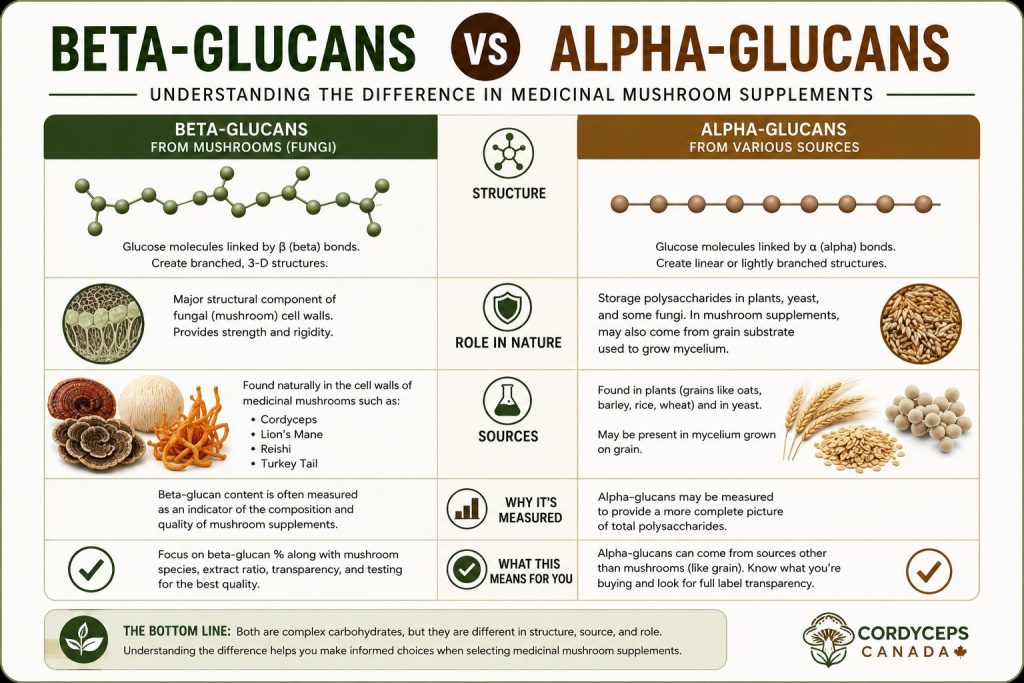
Although their names sound similar, they are different types of naturally occurring carbohydrates.
Beta-Glucans
Beta-glucans are structural components of fungal cell walls. They help provide strength and rigidity to the mushroom itself and are naturally present in the fruiting bodies and mycelium of medicinal mushrooms.
Alpha-Glucans
Alpha-glucans are also naturally occurring carbohydrates, but they can come from different sources.
For example, when mycelium is grown on grain, some alpha-glucans may originate from the grain itself. This is one reason why some manufacturers choose to report both beta-glucan and alpha-glucan values on their product labels.
Understanding the difference helps consumers better interpret supplement labels rather than relying on a single number or marketing claim.
How Are Beta-Glucans Measured?
Reputable manufacturers often use independent laboratories to analyze the composition of their mushroom products.
These laboratories use standardized testing methods to determine the concentration of naturally occurring compounds, including beta-glucans.
While the laboratory procedures are highly technical, the goal is simple: to provide accurate, consistent information about what’s in the product.
Third-party testing can also help verify additional quality factors, such as:
- Product identity
- Purity
- Moisture content
- Heavy metal screening
- Microbial testing
Companies that openly discuss their testing procedures demonstrate a commitment to transparency.
Reading a Supplement Label
When you pick up a medicinal mushroom supplement, don’t focus on just one number.
Instead, review the label as a whole.
A well-labeled product will often include:
✔ Mushroom species
✔ Fruiting body, mycelium, or both
✔ Serving size
✔ Extract ratio (if applicable)
✔ Beta-glucan content (when provided)
✔ Ingredient list
✔ Manufacturer information
✔ Recommended use
Together, these details provide a more complete picture of the product than any single measurement alone.
For a deeper look at supplement labels, read our guide:
How to Read a Medicinal Mushroom Supplement Label
Common Myths About Beta-Glucans
Myth: Beta-glucans are added to mushroom supplements.
Fact:
Beta-glucans occur naturally in medicinal mushrooms. They are not an ingredient that manufacturers add during production.
Myth: A higher percentage automatically means a better supplement.
Fact:
Beta-glucan content is one quality indicator, but it doesn’t tell the entire story. Mushroom species, cultivation methods, processing, transparency, and testing are all important factors to consider.
Myth: Only one type of mushroom contains beta-glucans.
Fact:
Many medicinal mushrooms naturally contain beta-glucans, including Cordyceps, Lion’s Mane, Reishi, and Turkey Tail.
Myth: Every mushroom supplement lists beta-glucan content.
Fact:
Some manufacturers disclose beta-glucan levels, while others do not. Labels vary from one product to another.
Questions to Ask Before Buying
When comparing medicinal mushroom supplements, consider asking:
- Does the company clearly identify the mushroom species?
- Does the label specify fruiting body, mycelium, or both?
- Is the ingredient list transparent?
- Is the extract ratio explained?
- Is beta-glucan content provided?
- Does the company discuss quality testing?
The more information a company shares, the easier it is for consumers to make informed decisions.
Frequently Asked Questions
Are beta-glucans found in all medicinal mushrooms?
Many medicinal mushrooms naturally contain beta-glucans as part of their cell wall structure, including Cordyceps, Lion’s Mane, Reishi, and Turkey Tail.
Are beta-glucans unique to mushrooms?
No. Beta-glucans are also found in sources such as oats, barley, and yeast, although their structures differ depending on the source.
Why don’t all labels list beta-glucans?
Labeling practices vary between manufacturers. Some companies choose to disclose beta-glucan content, while others provide different types of product information.
Should I only compare beta-glucan percentages?
No. Consider the entire product, including the mushroom species, ingredients, transparency, processing methods, and quality assurance.
Final Thoughts
Beta-glucans are one of the many naturally occurring compounds that make medicinal mushrooms unique. While they are often highlighted on supplement labels, they are only one part of understanding a product’s overall quality.
Learning how to interpret beta-glucan information alongside mushroom species, ingredient transparency, extract ratios, and testing practices can help you make more informed purchasing decisions.
Whether you’re exploring Cordyceps, Lion’s Mane, Reishi, or Turkey Tail, taking a few extra moments to read and understand the label is one of the best ways to choose products that match your preferences and wellness goals.
At Cordyceps Canada, we believe that education is just as important as the products themselves. By helping consumers understand what they’re buying, we hope to make choosing medicinal mushroom supplements a little clearer and a lot less confusing.