
Lion’s Mane and Memory: What Research Explores

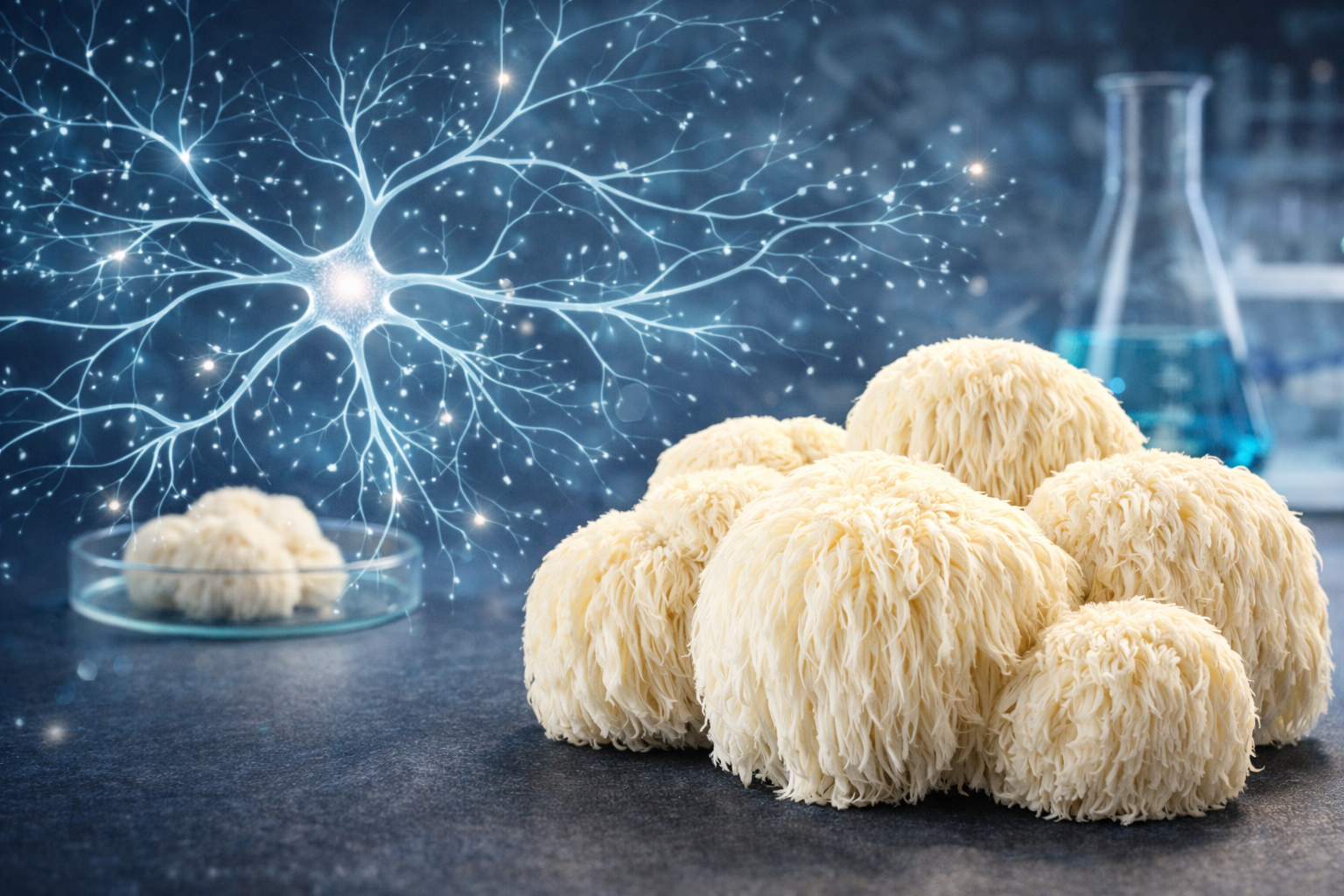
Quick Answer
Lion’s Mane (Hericium erinaceus) has attracted scientific interest because researchers have studied its naturally occurring compounds and their relationship to cognition, memory, and nervous-system biology.
A small number of human studies have reported interesting findings, particularly in older adults and people with cognitive impairment. However, the human evidence is still limited, studies have used different mushroom preparations, and results cannot automatically be applied to whole dried Lion’s Mane sold as food.
Research interest does not establish Lion’s Mane as a treatment for memory loss, dementia, Alzheimer’s disease, or ordinary forgetfulness.
Why Is Lion’s Mane Associated With Memory Research?
Lion’s Mane contains naturally occurring compounds that researchers continue to investigate.
Particular attention has been given to:
- hericenones
- erinacines
- beta-glucans
- polysaccharides
- sterols
- other fungal metabolites
Some laboratory and animal studies have examined how Lion’s Mane compounds interact with pathways involving nerve growth factor and other aspects of nervous-system biology.
Those findings helped generate interest in studying Lion’s Mane in human cognition.
For a broader introduction, see Lion’s Mane Mushroom: Research, Compounds, and Culinary Uses.
What Is Nerve Growth Factor?
Nerve growth factor, often abbreviated NGF, is a naturally occurring protein involved in the growth, maintenance, and survival of certain nerve cells.
Some Lion’s Mane compounds have been investigated for their relationship with NGF-related pathways.
This is scientifically interesting, but a laboratory effect involving NGF does not automatically mean that eating Lion’s Mane will improve memory in a person.
Biological mechanisms and demonstrated clinical outcomes are different types of evidence.
What Did the 2009 Memory Study Find?
One frequently cited human study involved 30 Japanese adults between 50 and 80 years old who had been diagnosed with mild cognitive impairment.
Participants received either Lion’s Mane mushroom powder or placebo for 16 weeks.
Researchers reported higher scores on the cognitive scale in the Lion’s Mane group at several points during the study. However, after the intervention ended, scores declined again during the following four weeks.
This was an interesting finding, but the study was small and involved a specific population with mild cognitive impairment.
It does not demonstrate that whole dried Lion’s Mane improves memory in healthy people generally.
What About Research in Older Adults?
Another randomized controlled study examined a Lion’s Mane fruiting-body preparation over 12 weeks.
Researchers used several cognitive tests. A significant difference was reported on one measure, while the other cognitive tests did not show the same pattern.
This illustrates an important point: a study can produce an encouraging result without demonstrating improvement across every measure of cognition.
What About Alzheimer’s Disease Research?
Researchers have also examined a preparation made from erinacine-A-enriched Lion’s Mane mycelium in people with mild Alzheimer’s disease.
A 49-week pilot study reported differences in some cognitive and functional measurements between the treatment and placebo groups.
However, this product was a specific enriched mycelial preparation.
It should not be treated as equivalent to whole dried Lion’s Mane fruiting bodies, ordinary mushroom powder, or culinary use.
That distinction is extremely important when interpreting mushroom research.
What Does Research in Healthy Younger Adults Show?
Evidence in healthy younger adults is much less convincing.
A small 2023 pilot study involving 41 healthy adults found faster performance on one cognitive task after an acute Lion’s Mane preparation, but many other outcomes were not significantly different. The researchers emphasized that larger studies were needed.
A later placebo-controlled study involving 18 healthy adults found no significant overall improvement in global cognition or mood after a standardized fruiting-body extract, although one individual task improved.
These mixed findings are why Lion’s Mane should not simply be advertised as a proven memory or focus enhancer.
For more about younger adults and studying, see Lion’s Mane and Students: What Research Says About Focus and Cognition.
What Do Systematic Reviews Tell Us?
A recent systematic review found that the human evidence base remains relatively small compared with the amount of laboratory research.
The review included five randomized controlled trials and several smaller clinical studies, alongside substantially more laboratory research.
This means there is enough evidence to justify continued scientific investigation, but not enough to treat Lion’s Mane as an established therapy for memory problems.
Memory Is Not One Single Function
When researchers talk about cognition or memory, they may be measuring very different things.
These can include:
- short-term memory
- working memory
- verbal recall
- visual memory
- attention
- processing speed
- executive function
- general cognitive screening scores
An improvement on one test does not necessarily mean that every aspect of memory has improved.
This is one reason broad statements such as “Lion’s Mane improves memory” can oversimplify the research.
Fruiting Body and Mycelium Matter
Lion’s Mane research uses different fungal materials.
Fruiting bodies and mycelium are biologically related but are not chemically identical.
Hericenones have been identified particularly in fruiting bodies, while erinacines are strongly associated with mycelium.
Some experimental preparations also concentrate specific compounds.
A result involving an enriched mycelial extract therefore cannot automatically be transferred to a whole dried fruiting body.
Whole Mushroom vs Extract
Whole dried Lion’s Mane retains the mushroom material after dehydration.
Extracts undergo additional processing designed to concentrate selected soluble components.
Clinical trials may use:
- dried mushroom powder
- fruiting-body extracts
- mycelial preparations
- standardized extracts
- enriched compounds
- capsules or tablets
These are not interchangeable products.
When reading a study, always check exactly what researchers used.
Does Lion’s Mane Prevent Memory Loss?
Current evidence is not strong enough to say that consuming Lion’s Mane prevents age-related memory loss.
Likewise, research does not establish whole dried Lion’s Mane as a prevention or treatment for dementia or Alzheimer’s disease.
Some studies are promising enough to justify further research, but that is different from having an established medical use.
Does Lion’s Mane Improve Everyday Forgetfulness?
There is no good evidence showing that ordinary everyday forgetfulness in healthy people will reliably improve from eating Lion’s Mane.
Forgetting a name, misplacing keys, or occasionally losing track of something can happen for many reasons, including:
- poor sleep
- stress
- distraction
- workload
- aging
- medication
- health conditions
A mushroom should not be assumed to address the cause.
Does Lion’s Mane Work Immediately?
Current evidence does not establish Lion’s Mane as an immediate memory enhancer.
Human studies have used very different schedules and preparations, and results are mixed.
Claims suggesting someone can take Lion’s Mane immediately before studying or an important task and expect better memory are not supported by strong evidence.
For more about timing, see Best Time of Day to Take Lion’s Mane.
What About Long-Term Use?
Some studies have investigated Lion’s Mane over periods ranging from several weeks to many months.
That does not establish a universal recommendation for how long consumers should use it.
Research schedules are designed for individual studies and should not automatically become consumer dosing instructions.
Long-term human evidence also remains limited.
How Can Whole Lion’s Mane Be Used as Food?
Whole dried Lion’s Mane is an edible mushroom.
It can be:
- simmered in water
- added to soups
- added to broths
- rehydrated for cooking
- ground into mushroom powder
- incorporated into other recipes
Using Lion’s Mane as food is different from taking a standardized research extract.
If you are looking for whole Canadian-grown fruiting bodies, visit Dried Lion’s Mane Mushrooms.
How to Read Memory Claims Carefully
When you encounter a claim that Lion’s Mane improves memory, ask:
- Was the study performed in humans?
- How many people were studied?
- Were they healthy or cognitively impaired?
- What age were they?
- Was there a placebo group?
- What Lion’s Mane preparation was used?
- Was it fruiting body or mycelium?
- Which cognitive test improved?
- Did all tests improve or only one?
- Has another independent study reproduced the result?
Those questions help distinguish legitimate research from exaggerated marketing.
Safety Still Matters
Lion’s Mane is an edible mushroom, but individual sensitivities and allergies can occur.
Safety information involving whole mushroom foods should also be distinguished from concentrated extracts and supplement preparations.
For more information, see Lion’s Mane Mushroom Safety: Myths, Facts, and Who Should Be Careful.
Frequently Asked Questions
Has Lion’s Mane been studied for memory?
Yes. Several human studies have examined cognition and memory-related measurements, particularly in older adults and people with cognitive impairment.
Does Lion’s Mane definitely improve memory?
No. Current human evidence is too limited and inconsistent to make that broad conclusion.
Has Lion’s Mane been studied in people with mild cognitive impairment?
Yes. A small placebo-controlled study reported improvements on a cognitive scale during a 16-week intervention, but the study included only 30 participants.
Has Lion’s Mane been studied in healthy young adults?
Yes, but studies have been small and results mixed. Some individual cognitive tasks have shown differences while overall cognition often has not.
Is Lion’s Mane proven to prevent dementia?
No. Current evidence does not establish Lion’s Mane as a proven prevention or treatment for dementia.
Is whole dried Lion’s Mane the same as the extracts used in studies?
Not necessarily. Many studies use specific powders, extracts, mycelial preparations, or standardized products that differ from whole dried fruiting bodies.
Final Thoughts
Lion’s Mane and memory are legitimately connected through scientific research, but the evidence is more complicated than many online claims suggest.
Small human studies have produced some encouraging findings, particularly in certain older or cognitively impaired populations. Other studies, especially in healthy younger adults, have found limited or mixed results.
The most accurate conclusion is that Lion’s Mane remains an interesting subject of cognitive research.
That is very different from saying whole dried Lion’s Mane has been proven to improve memory, prevent cognitive decline, or treat neurological disease.