
Lion’s Mane, Focus and Mental Clarity: What Research Suggests

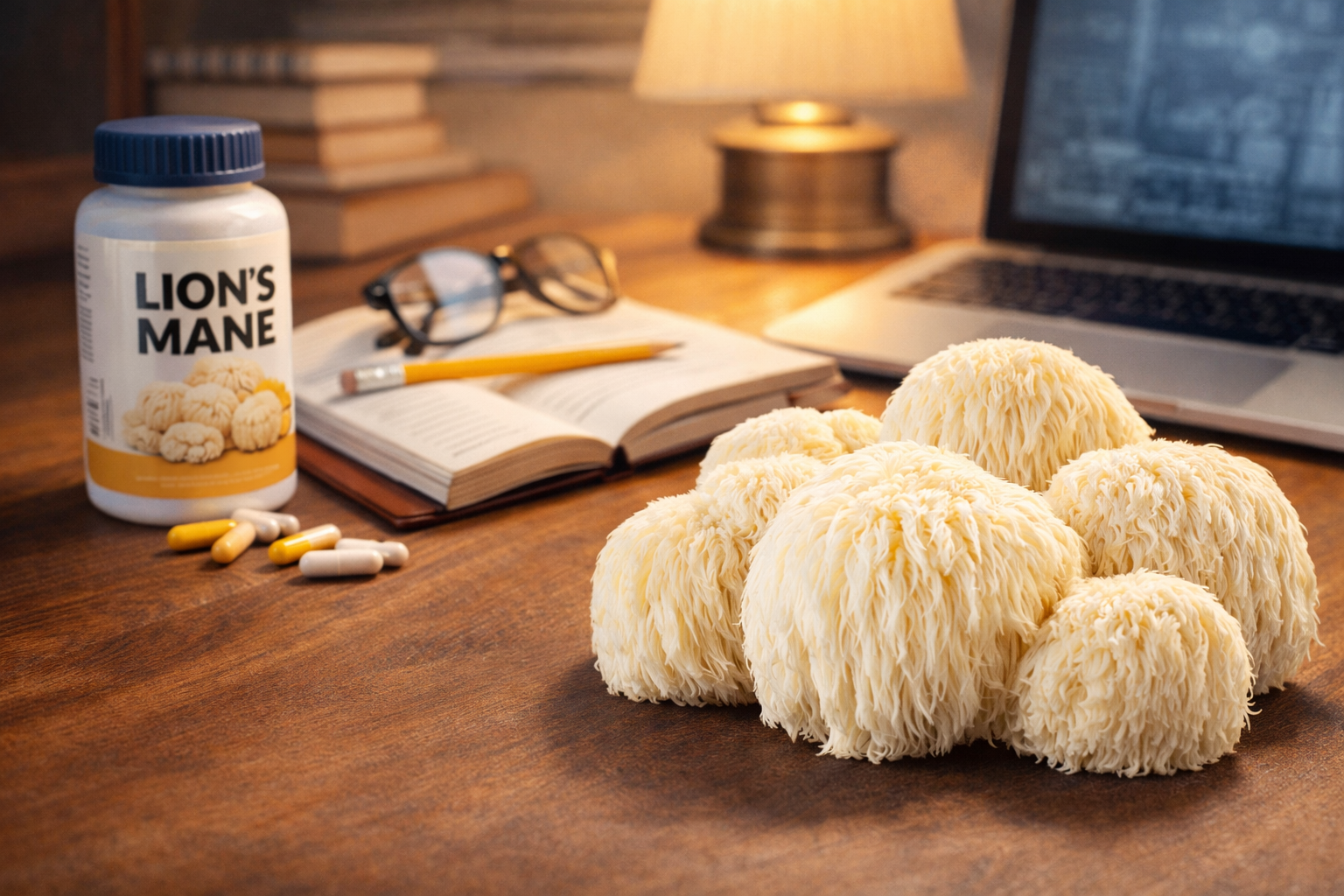
Quick Answer
Lion’s Mane (Hericium erinaceus) has been studied in relation to cognition, attention, working memory, and other aspects of mental performance.
A small number of human studies in healthy younger adults have reported some positive findings on individual cognitive tasks, but results have been mixed and overall evidence remains limited.
Current research does not establish Lion’s Mane as a proven treatment for poor concentration, brain fog, or attention problems.
Why Is Lion’s Mane Associated With Focus?
Interest in Lion’s Mane and cognition comes largely from research into naturally occurring compounds found in the mushroom.
These include:
- hericenones
- erinacines
- beta-glucans
- polysaccharides
- sterols
- other fungal metabolites
Some of these compounds have been investigated in laboratory and animal studies involving nervous-system biology.
That research has contributed to Lion’s Mane becoming popular in discussions about focus and cognitive performance.
For a broader overview, see Lion’s Mane Mushroom: Research, Compounds, and Culinary Uses.
What Does “Focus” Mean in Research?
Focus is not one single scientific measurement.
Researchers may test:
- attention
- reaction time
- working memory
- processing speed
- executive function
- task accuracy
- cognitive flexibility
An improvement on one test does not necessarily mean that a person has broadly improved “mental clarity.”
This is why individual study results should be interpreted carefully.
What Does Research in Healthy Younger Adults Show?
A 2023 randomized pilot study involved 41 healthy adults between 18 and 45 years old.
Researchers examined both a single administration and 28 days of Lion’s Mane use.
Participants performed faster on one Stroop-task measure after the acute administration, but many other outcomes were not significantly different. The researchers described the findings as preliminary and emphasized the need for larger studies.
This is interesting evidence, but not enough to conclude that Lion’s Mane reliably improves focus.
What Did a 2025 Study Find?
A 2025 double-blind placebo-controlled study examined a standardized Lion’s Mane fruiting-body extract in 18 healthy adults aged 18 to 35.
Researchers tested working memory, executive function, attention, information-processing speed, psychomotor performance, and mood.
They found no significant overall improvement in global cognitive performance or mood compared with placebo.
One individual psychomotor task improved, but the researchers concluded that further investigation was needed.
This is a useful reminder that one positive task result should not be turned into a broad claim that Lion’s Mane improves mental performance.
Why Do Studies Sometimes Produce Different Results?
Differences can come from:
- participant age
- sample size
- mushroom preparation
- fruiting body versus mycelium
- extract concentration
- study duration
- cognitive tests used
- statistical methods
- individual variation
Two Lion’s Mane studies may therefore be investigating quite different products under very different conditions.
Whole Mushroom and Extracts Are Not the Same
Whole dried Lion’s Mane consists of dehydrated fruiting-body material.
Research studies may instead use:
- powdered fruiting body
- concentrated fruiting-body extract
- mycelium
- enriched mycelial preparations
- capsules
- standardized extracts
These preparations are not automatically interchangeable.
A finding involving a concentrated extract should not automatically be used to describe whole dried Lion’s Mane sold as food.
For more information, see Fruiting Body vs Mycelium: What’s the Difference?
What About Lion’s Mane and “Brain Fog”?
“Brain fog” is an informal term rather than a specific medical diagnosis.
People may use it to describe:
- difficulty concentrating
- mental fatigue
- forgetfulness
- slowed thinking
- distraction
These experiences can have many possible causes, including lack of sleep, stress, medication, illness, nutrition, and other health factors.
Current research does not establish Lion’s Mane as a treatment for brain fog.
Does Lion’s Mane Work Immediately?
There is not enough evidence to say that Lion’s Mane reliably creates an immediate improvement in concentration.
Some studies have tested acute effects within one or two hours, but findings have been inconsistent.
For example, a 2025 study found no significant improvement in overall cognitive performance 90 minutes after a standardized extract.
That makes claims such as “take Lion’s Mane before work for instant focus” difficult to support.
Does Daily Use Improve Focus?
Research has also examined Lion’s Mane over several weeks.
However, current studies are too small and inconsistent to establish that daily use will reliably improve concentration in healthy adults.
Study schedules should also not automatically become consumer recommendations.
Lion’s Mane Is Not the Same as Caffeine
Lion’s Mane does not naturally contain caffeine.
Caffeine is a stimulant with well-characterized effects on alertness and the central nervous system.
Lion’s Mane is an edible mushroom containing numerous naturally occurring compounds being investigated in different areas of research.
They should not be treated as equivalent.
Can Lion’s Mane Be Used With Coffee?
From a culinary perspective, Lion’s Mane powder can be added to coffee or other beverages.
Any stimulant effect from ordinary coffee comes primarily from caffeine.
Combining Lion’s Mane with coffee does not establish that the mushroom enhances or extends the effect of caffeine.
What About Students and Professionals?
Lion’s Mane has become popular among students, office workers, creators, and people interested in productivity.
That popularity does not demonstrate effectiveness.
Research involving healthy younger adults remains small, and results are mixed.
Does Timing Matter?
There is no established best time of day for using whole dried Lion’s Mane as food.
Research studies use different schedules for experimental reasons, but those schedules do not prove that morning, afternoon, or evening is superior.
For more information, see Best Time of Day to Take Lion’s Mane.
What About Memory?
Focus and memory overlap in some cognitive tasks, but they are not identical.
Lion’s Mane has also been investigated in memory-related research, particularly in older adults and people with cognitive impairment.
Those studies should not automatically be applied to healthy people seeking better concentration.
For more information, see Lion’s Mane and Memory: What Research Explores.
How Can Whole Lion’s Mane Be Used as Food?
Whole dried Lion’s Mane is an edible mushroom.
It can be:
- simmered in water
- added to broths
- added to soups
- rehydrated for cooking
- ground into mushroom powder
- incorporated into recipes
If you are looking for whole Canadian-grown fruiting bodies, see Dried Lion’s Mane Mushrooms.
How to Evaluate Focus Claims
When reading a claim that Lion’s Mane improves focus, ask:
- Was the study performed in humans?
- How many people participated?
- Was there a placebo group?
- Were participants healthy?
- What age were they?
- Which Lion’s Mane preparation was tested?
- Was it fruiting body or mycelium?
- Did overall cognition improve?
- Or did only one task show a difference?
- Has another independent study reproduced the finding?
These questions help separate research findings from advertising.
What Do Reviews Say About the Evidence?
A recent systematic review found that the Lion’s Mane evidence base includes only a limited number of randomized and pilot clinical trials compared with a much larger body of laboratory research.
That supports continued scientific interest, but it also means broad claims about focus and mental clarity are premature.
Safety Considerations
Lion’s Mane is an edible mushroom, but individual sensitivities and allergies are possible.
Whole food products should also be distinguished from concentrated extracts and other supplement-style preparations.
For more information, see Lion’s Mane Mushroom Safety: Myths, Facts, and Who Should Be Careful.
Frequently Asked Questions
Does Lion’s Mane improve focus?
Current human research is too limited and inconsistent to make that broad conclusion.
Has Lion’s Mane been studied in healthy young adults?
Yes. A small number of controlled studies have included healthy younger adults, but sample sizes have been small and findings mixed.
Does Lion’s Mane treat brain fog?
Current evidence does not establish Lion’s Mane as a treatment for brain fog.
Does Lion’s Mane contain caffeine?
No. Hericium erinaceus does not naturally contain caffeine.
Does Lion’s Mane work immediately?
There is not enough evidence to say that it reliably produces an immediate improvement in focus.
Can Lion’s Mane be added to coffee?
Yes, as a food ingredient. The caffeine effect still comes primarily from the coffee.
Is whole dried Lion’s Mane the same as the extract used in a study?
No. Whole mushrooms and concentrated research preparations can differ substantially.
Final Thoughts
Lion’s Mane has a legitimate place in cognitive research, including studies involving attention, working memory, reaction time, and other measures.
But current human evidence is still limited.
Some individual cognitive tasks have shown interesting results, while other studies have found no significant improvement in overall cognitive performance.
The most accurate conclusion is that Lion’s Mane remains an interesting subject of research—not that it has been proven to improve focus, eliminate brain fog, or enhance mental performance.