
Fruiting Body vs Mycelium: What’s the Difference?


When shopping for medicinal mushroom supplements, you’ve probably seen terms like fruiting body, mycelium, or mycelium on grain on product labels. These terms are often used in marketing, but what do they actually mean?
Understanding the difference between fruiting bodies and mycelium can help you make more informed decisions when choosing mushroom products. Rather than focusing on marketing claims, it’s useful to understand what each part of the fungus is, how it grows, and why manufacturers may choose one, the other, or a combination of both.
In this guide, we’ll explain the differences in simple terms and show you what to look for when reading a medicinal mushroom supplement label.
What Is a Mushroom?
Many people think the mushroom is the entire organism.
In reality, the mushroom you see growing above the surface is only one part of a much larger living organism.
Most of the fungus lives hidden inside wood, soil, or another growing substrate as an interconnected network of microscopic threads called mycelium.
When environmental conditions are right, the fungus produces a visible reproductive structure known as the fruiting body—the part most people recognize as a mushroom.
What Is Mycelium?
Mycelium is the vegetative part of a fungus.
It consists of millions of tiny branching filaments called hyphae that spread through a growing medium, breaking down organic material and absorbing nutrients.
Think of mycelium as the fungus’s nutrient-collecting network.
Although it’s often compared to the roots of a plant, mycelium is not a root system. Plants and fungi belong to entirely different biological kingdoms and function differently.
Before a mushroom ever appears, the fungus spends much of its life growing as mycelium.
What Is the Fruiting Body?
The fruiting body is the visible mushroom that develops when environmental conditions encourage reproduction.
Its primary purpose is to produce and release spores, allowing the fungus to reproduce and continue its life cycle.
Examples include:
- Cordyceps fruiting bodies
- Lion’s Mane mushrooms
- Reishi conks
- Turkey Tail shelves
These are the mushrooms most people recognize and are commonly dried, powdered, or extracted for use in supplements.
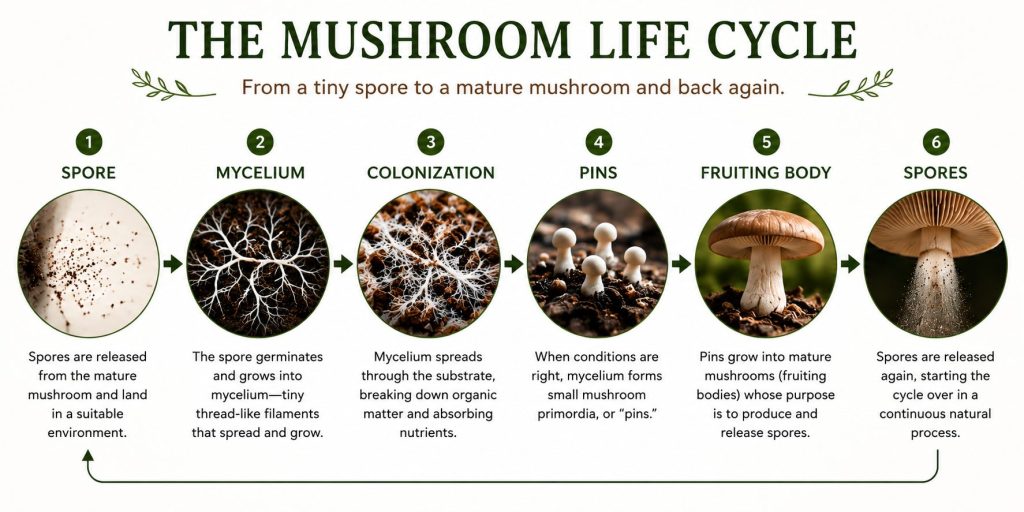
The Mushroom Life Cycle
Understanding the life cycle helps explain why both mycelium and fruiting bodies exist.
The process generally follows these stages:
- A spore lands on a suitable growing surface.
- The spore germinates and begins forming mycelium.
- The mycelium colonizes its food source.
- When temperature, humidity, light, and other environmental conditions are favorable, small mushroom pins begin to form.
- These pins develop into mature fruiting bodies.
- Mature mushrooms release spores, beginning the cycle again.
Each stage plays an essential role in the fungus’s life.

Fruiting Body vs Mycelium
Although they are parts of the same organism, they are not identical.
| Fruiting Body | Mycelium |
|---|---|
| Visible mushroom | Microscopic network of hyphae |
| Forms above the growing substrate | Grows within the substrate |
| Produces spores | Absorbs nutrients and supports growth |
| Commonly dried for powders and extracts | Can also be processed into supplements |
Neither is “fake.” They are simply different parts of the same fungus.
What Does “Mycelium on Grain” Mean?
This is one of the most misunderstood phrases on supplement labels.
Many manufacturers grow mycelium on sterilized grains such as oats, rice, or millet.
As the mycelium grows, it colonizes the grain. Depending on how the product is processed, the final ingredient may contain both fungal mycelium and portions of the original grain.
Some companies clearly disclose this on their labels, while others use different terminology.
Understanding these labels helps consumers compare products more confidently.
Why Do Some Companies Use Fruiting Bodies?
Many manufacturers choose fruiting bodies because they are the recognizable mushroom structure and are commonly used in traditional preparations.
Fruiting bodies can be dried and sold whole, ground into powders, or processed into extracts.
Many consumers specifically look for products labeled 100% fruiting body, while others prefer products that combine different parts of the fungus.
The most important factor is transparency. A quality label should clearly explain what part of the fungus is being used.
Reading the Label
When evaluating a medicinal mushroom supplement, look for information such as:
- Mushroom species
- Fruiting body, mycelium, or both
- Extract ratio (if applicable)
- Beta-glucan content (when provided)
- Third-party testing
- Ingredient list
- Serving size
For a more detailed guide, read our article:
How to Read a Medicinal Mushroom Supplement Label
Common Myths
Myth: Fruiting body and mycelium are different organisms.
Fact: They are two parts of the same fungal organism.
Myth: Every supplement contains only mushrooms.
Fact: Products can contain fruiting bodies, mycelium, or mycelium grown on grain. Reading the ingredient label helps you understand what you’re purchasing.
Myth: Labels don’t matter.
Fact: Product labels provide valuable information about ingredients, processing methods, serving sizes, and testing.
Questions to Ask Before Buying
Before purchasing any medicinal mushroom supplement, ask yourself:
✓ Does the label identify the mushroom species?
✓ Does it specify fruiting body, mycelium, or both?
✓ Is the extract ratio listed?
✓ Are beta-glucans disclosed?
✓ Does the company mention third-party testing?
✓ Is the ingredient list easy to understand?
Transparency helps consumers make informed decisions.
Frequently Asked Questions
Is mycelium a mushroom?
Mycelium is part of the fungal organism. The visible mushroom is the fruiting body.
Can supplements contain both fruiting body and mycelium?
Yes. Some products contain one, while others contain a combination.
Why do companies grow mycelium on grain?
Grain provides nutrients that allow the mycelium to grow during cultivation.
Is one always better than the other?
Different products are made for different purposes. Rather than relying on broad claims, look for transparent labeling, reputable manufacturers, and products that clearly describe their ingredients.
Final Thoughts
Understanding the difference between fruiting bodies and mycelium isn’t about choosing sides—it’s about becoming an informed consumer.
By learning how mushrooms grow, understanding supplement labels, and recognizing the different parts of the fungal life cycle, you’ll be better equipped to compare products and choose those that align with your preferences and wellness goals.
Whether you’re interested in Cordyceps, Lion’s Mane, Reishi, or Turkey Tail, taking the time to understand what’s inside the package is one of the best ways to make a confident purchasing decision.
For more educational guides, explore our articles on How to Read a Medicinal Mushroom Supplement Label, Medicinal Mushroom Stacking, and our individual guides for Cordyceps, Lion’s Mane, Reishi, and Turkey Tail.