
Reishi Mushroom Side Effects: Safety & Who Should Avoid It

Quick Answer
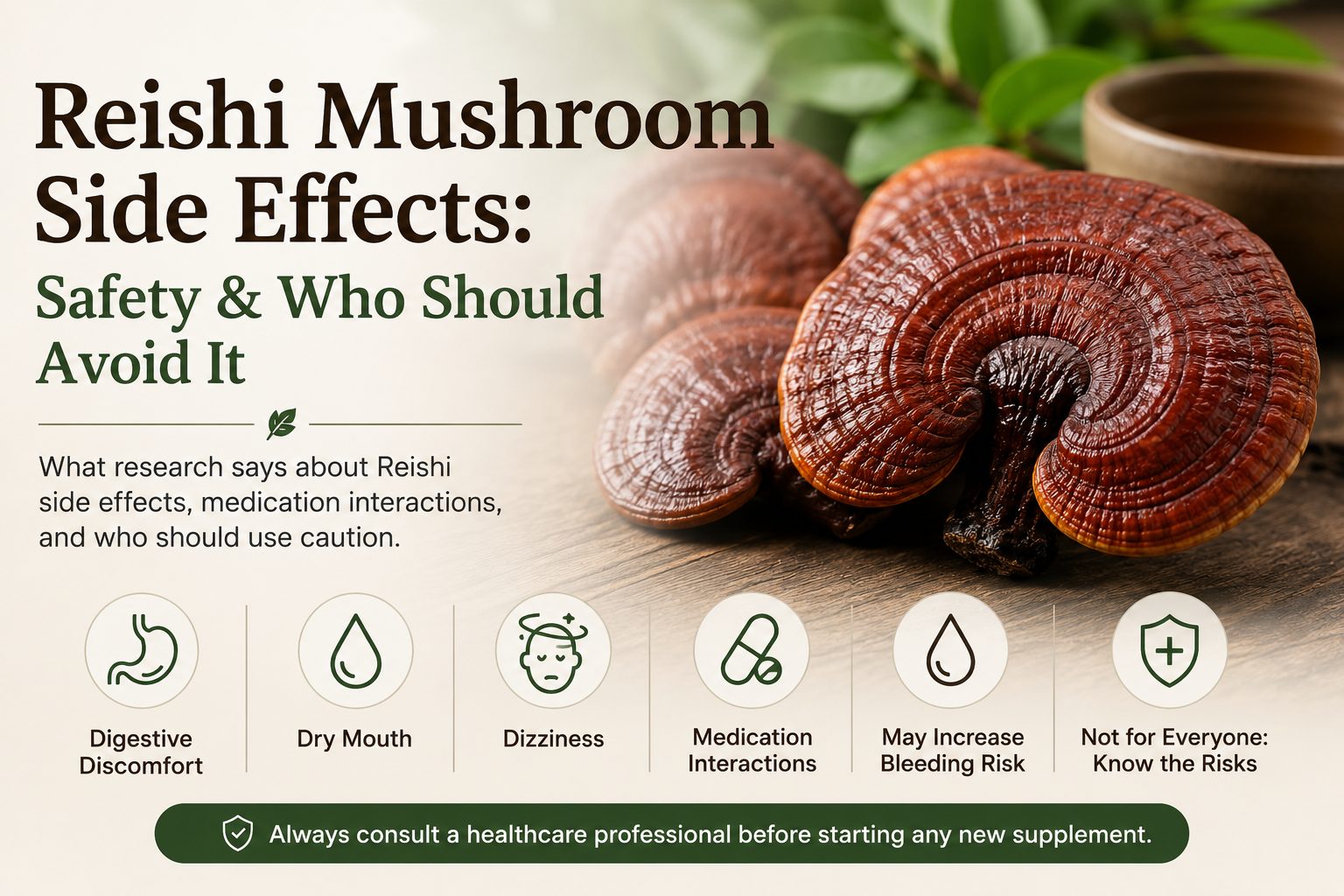
Reishi mushrooms are generally well tolerated by many adults, but they can cause side effects and may interact with certain medications. Reported effects include nausea, digestive discomfort, dry mouth, dizziness, itching, and difficulty sleeping. Rare cases of liver injury have also been reported. People taking blood thinners or immunosuppressant medications, those with mushroom allergies, and anyone receiving medical treatment should speak with a healthcare professional before using Reishi supplements.
Is Reishi Mushroom Safe?
Reishi has a long history of traditional use in East Asia and is now commonly available as dried mushroom, powder, tea, capsules, and concentrated extracts.
Clinical research suggests that Reishi is generally well tolerated during short-term use. However, studies in humans are relatively small, and there is less information about the safety of long-term or high-dose supplementation.
The important point is that natural does not automatically mean risk-free. Reishi contains biologically active compounds, including polysaccharides and triterpenoids, that can affect the body.
What Are the Most Common Reishi Side Effects?
Reported side effects of Reishi include:
- Nausea
- Digestive discomfort
- Dry mouth
- Constipation
- Dizziness
- Itching
- Difficulty sleeping
Not everyone experiences these effects, and many people tolerate Reishi without problems.
If you experience persistent or worsening symptoms after beginning a Reishi product, stop using it and speak with a healthcare professional.
Can Reishi Affect the Liver?
This deserves some context because claims about Reishi and liver damage can sound more alarming than the available evidence supports.
The National Institutes of Health’s LiverTox database reports that Reishi has not generally been associated with elevated liver enzymes in controlled clinical trials. However, a small number of cases of acute liver injury have been reported.
Because Reishi is consumed extensively worldwide and these reports are uncommon, LiverTox classifies it as a possible but rare cause of clinically apparent liver injury. Some reported cases also involved other factors that made it difficult to establish Reishi as the definite cause.
Anyone who develops unusual fatigue, abdominal pain, dark urine, loss of appetite, or yellowing of the skin or eyes while taking a supplement should stop taking it and seek medical attention.
Can Reishi Interact With Medications?
Yes. This is one of the most important safety considerations.
Blood Thinners
Reishi may increase bleeding risk when combined with anticoagulant or antiplatelet medications.
Memorial Sloan Kettering specifically advises people taking blood thinners such as warfarin to speak with their healthcare provider before using Reishi.
Immunosuppressant Medications
Reishi is being studied for its effects on immune function. Because of this activity, it could potentially interfere with medications designed to suppress the immune system.
People taking immunosuppressants should therefore consult their healthcare provider before using Reishi supplements.
Who Should Avoid Reishi or Speak With a Healthcare Professional First?
Extra caution is appropriate if you:
- Take anticoagulant or antiplatelet medications
- Take immunosuppressant medications
- Have a bleeding disorder
- Have a known mushroom allergy
- Have liver disease or a history of liver problems
- Are preparing for surgery
- Are undergoing chemotherapy, radiation therapy, or other medical treatment
- Are pregnant or breastfeeding
Pregnancy and breastfeeding deserve particular caution because there isn’t enough high-quality human research to establish Reishi’s safety in these situations.
What About Reishi Before Surgery?
Because of the potential effect on blood clotting, anyone scheduled for surgery should tell their healthcare team about Reishi and all other supplements they use.
Don’t simply assume that a mushroom supplement is irrelevant because it is natural.
Your surgeon or healthcare provider can tell you whether it should be discontinued and, if so, when.
Does the Type of Reishi Product Matter?
Yes.
Reishi products can include:
- Whole dried fruiting bodies
- Ground mushroom powders
- Hot-water extracts
- Alcohol extracts
- Dual extracts
- Spore products
- Mycelium-based products
These aren’t necessarily equivalent.
The concentrations of polysaccharides, triterpenoids, and other compounds can vary substantially depending on the species, growing method, part of the fungus used, extraction method, and product quality.
This is one reason it’s important to know exactly what you’re buying rather than assuming every product labelled “Reishi” is the same.
Quality Matters for Safety Too
Safety isn’t determined solely by the mushroom itself.
Poorly manufactured supplements can introduce additional concerns such as contamination, incorrect species identification, undeclared ingredients, or inconsistent concentrations.
Look for products that clearly identify the mushroom species and the part of the mushroom used, and choose producers that are transparent about cultivation, processing, and testing.
What Does the Research Say?
Research into Reishi continues, but the current evidence supports a balanced conclusion.
Short-term clinical trials generally report relatively few serious adverse effects. A recent systematic review incorporating 17 randomized controlled trials and 971 participants found no significant overall changes in liver enzymes, although the researchers also noted that results varied depending on factors such as dose, duration, age, and health condition.
At the same time, rare adverse reactions and potential medication interactions have been documented.
So the evidence doesn’t support describing Reishi as either dangerous or completely risk-free.
For most people, the more accurate description is: generally well tolerated when used appropriately, with important exceptions for certain individuals and medications.
Related Guides
You may also find these articles helpful:
- Reishi Mushroom Health Benefits: Traditional Uses & Modern Science
- Reishi for Stress & Relaxation
- Do Medicinal Mushrooms Have Side Effects?
- Mushroom Extracts Explained
Frequently Asked Questions
Can Reishi cause side effects?
Yes. Reported effects include nausea, dry mouth, digestive problems, dizziness, itching, and insomnia. Many people experience no noticeable side effects.
Is Reishi hard on the liver?
Usually not. Controlled studies have generally not found significant liver-enzyme abnormalities, but rare cases of liver injury have been reported.
Can I take Reishi if I take medication?
It depends on the medication. Reishi may interact particularly with blood-thinning and immunosuppressant medications. Discuss your medications and supplements with your healthcare provider before combining them.
Can I take Reishi every day?
Many Reishi products are intended for regular use, but there is less high-quality evidence about prolonged use than short-term use. Follow the directions for your particular product and consult a healthcare professional if you have medical conditions or take medications.
Can I be allergic to Reishi?
Yes. Anyone with a known mushroom allergy should avoid Reishi unless their healthcare provider advises otherwise.