
Mushroom Extracts Explained: Water Extract vs Alcohol Extract vs Dual Extract

Understanding One of the Most Important Parts of Choosing a Mushroom Supplement
If you’ve ever compared medicinal mushroom supplements, you’ve probably seen terms such as water extract, alcohol extract, or dual extract on product labels. For many people, these terms can be confusing, making it difficult to know what they actually mean or whether one type of extract is better than another.
The good news is that the concept is much simpler than it first appears.
Extraction is simply a process used to separate and concentrate naturally occurring compounds found within mushrooms. Different extraction methods are used because some compounds dissolve better in water, while others dissolve more effectively in alcohol.
Understanding these extraction methods can help you make more informed decisions when comparing mushroom products and reading supplement labels.
In this guide, we’ll explain the differences between water extracts, alcohol extracts, and dual extracts, why manufacturers use them, and what to look for when choosing a quality medicinal mushroom supplement.
Why Are Mushrooms Extracted?
Medicinal mushrooms contain a variety of naturally occurring compounds locked within tough fungal cell walls.
These cell walls are primarily made of chitin, the same structural material found in the shells of insects and crustaceans. Chitin is extremely durable and difficult for the human digestive system to break down completely.
Extraction helps release many of the naturally occurring compounds contained inside these cell walls, making them available in a concentrated form.
Rather than changing the mushroom, extraction simply separates specific compounds using carefully controlled processes.
What Is a Water Extract?
Water extraction is the oldest and most traditional method of preparing medicinal mushrooms.
In fact, people have been making water extracts for centuries without realizing it.
Every time someone prepares mushroom tea or simmers mushrooms in soup for an extended period, they are performing a simple water extraction.
Modern manufacturers use carefully controlled temperatures, pressure, and time to produce concentrated water extracts.
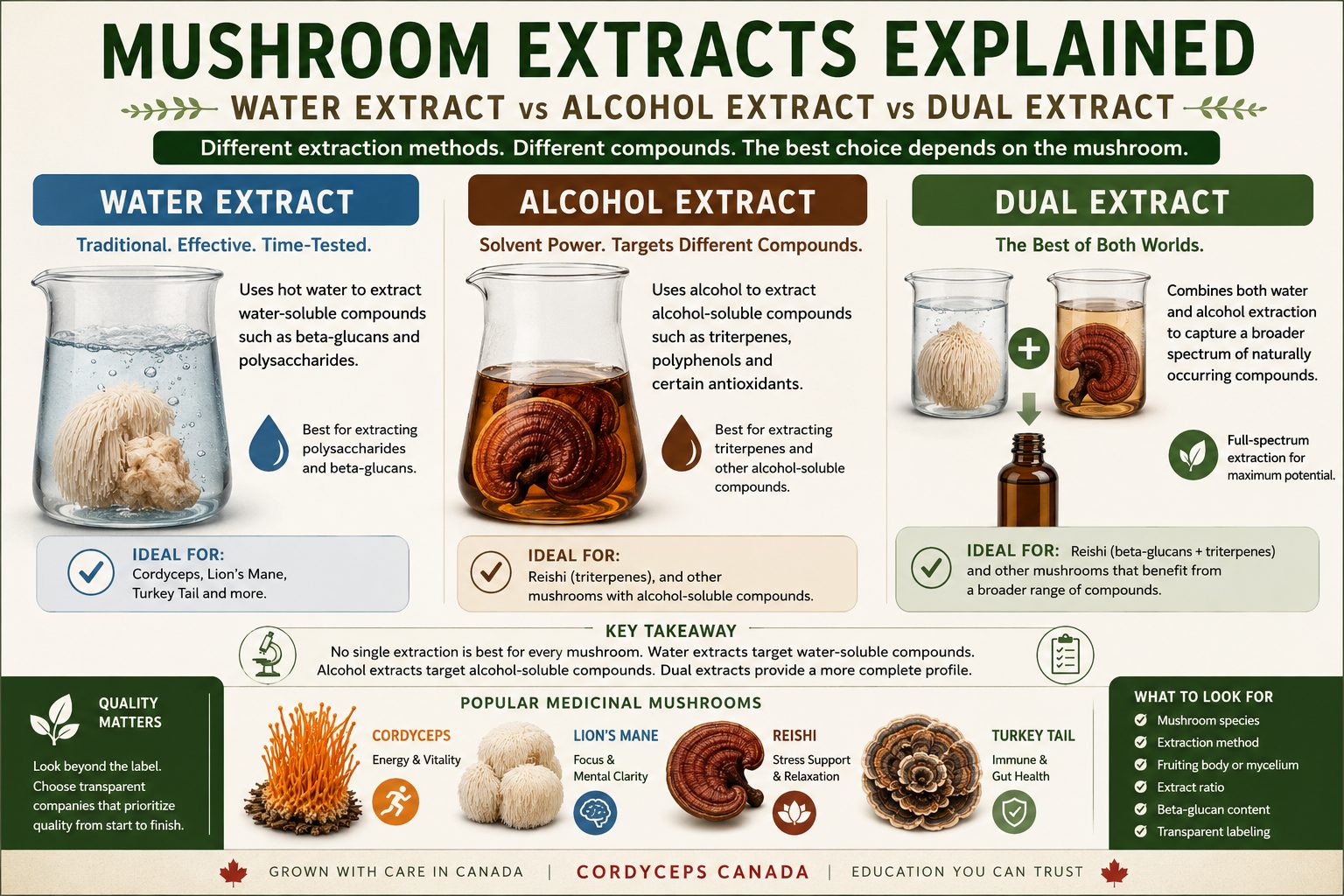
Water extraction is particularly effective at dissolving water-soluble compounds, including many naturally occurring polysaccharides and beta-glucans.
For mushrooms such as:
- Turkey Tail
- Lion’s Mane
- Cordyceps
water extraction is commonly used because many important naturally occurring compounds are water soluble.
Advantages of Water Extraction
Water extraction offers several benefits.
✔ Traditional preparation method
✔ Excellent for extracting beta-glucans
✔ Suitable for many medicinal mushroom species
✔ Commonly used in powdered extracts
However, water does not dissolve every naturally occurring compound found in mushrooms.
Some compounds require a different solvent.
What Is an Alcohol Extract?
Some medicinal mushrooms contain naturally occurring compounds that are not readily dissolved in water.
Instead, these compounds dissolve more effectively in alcohol.
Alcohol extraction allows manufacturers to isolate compounds that would otherwise remain largely unavailable during water extraction alone.
One of the best-known examples is Reishi (Ganoderma lucidum).
Reishi naturally contains compounds called triterpenes, which are much more soluble in alcohol than in water.
Because of this, alcohol extraction is commonly used when producing Reishi tinctures and certain concentrated extracts.
Advantages of Alcohol Extraction
Alcohol extraction offers several advantages.
✔ Extracts alcohol-soluble compounds
✔ Frequently used for Reishi
✔ Produces concentrated liquid tinctures
✔ Complements water extraction for some mushroom species
Like water extraction, however, alcohol extraction also has limitations.
It does not efficiently extract every compound found within medicinal mushrooms.
This is where dual extraction becomes useful.
What Is a Dual Extract?
A dual extract combines both water extraction and alcohol extraction.
Rather than relying on a single solvent, manufacturers perform two separate extraction processes before combining the resulting extracts into one finished product.
The goal is to obtain a broader range of naturally occurring compounds than either extraction method could produce alone.
For certain mushroom species—particularly Reishi—dual extraction has become one of the most common preparation methods.
Instead of asking whether water or alcohol extraction is “better,” it’s often more accurate to ask which extraction method is most appropriate for the specific mushroom species and the naturally occurring compounds it contains.
Why Don’t All Mushrooms Need Dual Extraction?
This is one of the most common misconceptions.
Many people assume every medicinal mushroom should automatically be dual extracted.
In reality, different mushroom species contain different naturally occurring compounds.
Some species are commonly prepared using primarily water extraction, while others benefit from combining both water and alcohol extraction.
A reputable manufacturer chooses an extraction method based on the mushroom itself rather than using the same process for every species.
Which Extraction Method Is Best?
One of the most common questions people ask is:
“Which extraction method is the best?”
The answer depends on the mushroom species and the naturally occurring compounds you are hoping to extract.
There is no single extraction method that is superior for every mushroom.
For example:
- Cordyceps is commonly prepared using water extraction because many of its naturally occurring polysaccharides are water soluble.
- Lion’s Mane is also frequently available as a water extract.
- Reishi is often produced as a dual extract because it contains both water-soluble beta-glucans and alcohol-soluble triterpenes.
- Turkey Tail is commonly processed using water extraction to concentrate its naturally occurring polysaccharides.
A reputable manufacturer selects an extraction process based on the biology of the mushroom rather than applying the same method to every species.
Does Extraction Make a Mushroom Better?
Extraction doesn’t make a mushroom “better.”
Instead, it changes how naturally occurring compounds are prepared and concentrated.
Think of making tea.
When you steep tea leaves in hot water, you’re extracting flavour, aroma, and naturally occurring compounds from the leaves into the water.
Mushroom extraction works in much the same way, although commercial extraction is carefully controlled to achieve consistent results.
The goal is not to improve the mushroom but to make certain naturally occurring compounds more available in the finished product.
Understanding Extract Ratios
When shopping for mushroom supplements, you may see labels such as:
- 4:1
- 8:1
- 10:1
These are known as extract ratios.
An extract ratio indicates how much raw mushroom material was used to produce a given amount of extract.
However, extract ratios should never be viewed as the only measure of quality.
A higher ratio does not automatically mean a better product.
The quality of the mushroom, cultivation methods, extraction process, and manufacturing standards are equally important.
Reading an Extract Label
A quality mushroom supplement label should provide clear, transparent information.
Look for details such as:
✔ Mushroom species
✔ Fruiting body, mycelium, or both
✔ Extraction method (when provided)
✔ Extract ratio
✔ Serving size
✔ Ingredient list
✔ Beta-glucan content (when available)
The more transparent a company is about its products, the easier it is to make informed comparisons.
For more information, read our guide:
How to Read a Medicinal Mushroom Supplement Label
Common Myths About Mushroom Extracts
Myth: Dual extracts are always better.
Fact:
Not necessarily.
Dual extraction is an excellent choice for some mushroom species, but not every mushroom requires both water and alcohol extraction.
Myth: Water extracts are weak.
Fact:
Water extraction has been used for centuries and remains one of the most effective ways to obtain many naturally occurring polysaccharides and beta-glucans.
Myth: Alcohol extracts contain alcohol when you take them.
Fact:
Many liquid tinctures contain alcohol as part of the finished product, while many dried extracts have the alcohol removed during manufacturing.
Always read the product label to understand how a specific supplement has been prepared.
Myth: A higher extract ratio always means a stronger product.
Fact:
Extract ratios are only one piece of the puzzle.
Quality depends on the mushroom species, cultivation methods, extraction process, ingredient transparency, and manufacturing practices.
Frequently Asked Questions
Why don’t all mushrooms use the same extraction method?
Different mushrooms contain different naturally occurring compounds. Manufacturers choose extraction methods based on the compounds they wish to concentrate.
Is mushroom tea considered a water extract?
Yes.
Traditional mushroom tea is one of the oldest forms of water extraction.
Why is Reishi often dual extracted?
Reishi naturally contains compounds that dissolve well in water as well as compounds that dissolve more effectively in alcohol. Using both extraction methods allows manufacturers to capture a broader range of naturally occurring compounds.
Can I compare products using extract ratios alone?
No.
Extract ratios should always be considered alongside the mushroom species, ingredient list, extraction method, and manufacturer transparency.
Final Thoughts
Understanding mushroom extraction methods can make reading supplement labels much less confusing.
Water extraction, alcohol extraction, and dual extraction each have their place, and no single method is universally superior. The best extraction process depends on the mushroom species and the naturally occurring compounds it contains.
Rather than focusing on marketing claims, take the time to look at the complete picture. Consider the mushroom species, extraction method, ingredient transparency, extract ratios, and quality testing when comparing products.
At Cordyceps Canada, we believe that informed consumers make better decisions. By understanding how mushroom extracts are prepared, you’ll be better equipped to choose products that match your goals and preferences.
Continue your Learning Centre journey with these related guides: