
How Cordyceps Liquid Extracts Are Prepared from Dried Fruiting Bodies

Quick Answer
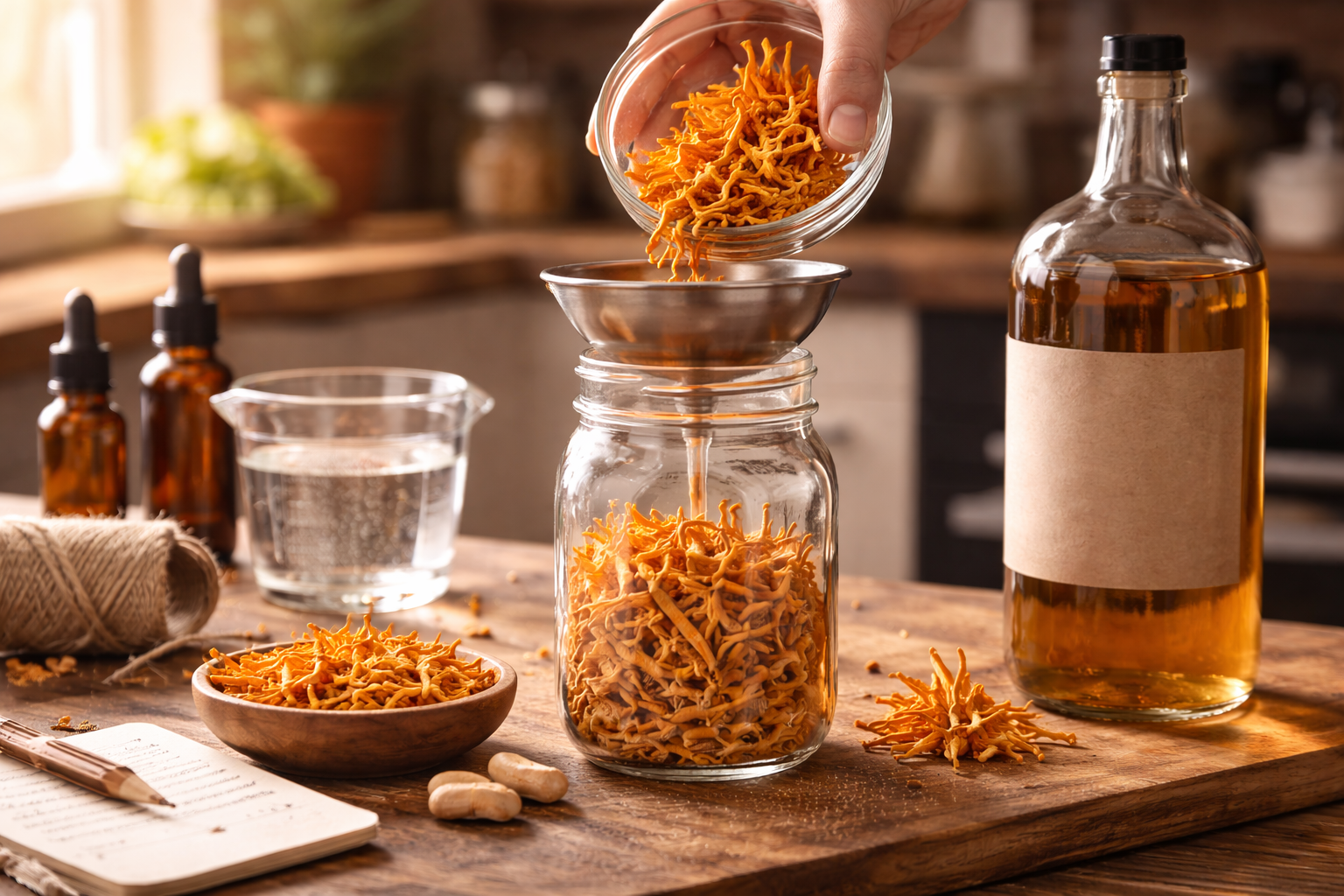
Dried Cordyceps militaris can be processed with water, alcohol, or a combination of the two to produce a liquid mushroom extract.
Water and alcohol have different solvent properties, so different preparation methods can recover different groups of naturally occurring mushroom compounds.
This article explains the preparation process for educational purposes. It does not establish a therapeutic use, dosage, potency, shelf life, or health benefit for the finished liquid.
Why Start With Dried Fruiting Bodies?
Whole dried Cordyceps fruiting bodies provide a clearly identifiable starting material.
Before extraction, the mushroom material should be:
- correctly identified as Cordyceps militaris
- fully dried
- free from visible mould or spoilage
- stored properly
- handled with clean equipment
For information about evaluating dried mushrooms, see How to Choose High-Quality Cordyceps Mushrooms.
What Is a Liquid Mushroom Extract?
A liquid mushroom extract is produced by exposing mushroom material to a solvent.
Common extraction liquids include:
- water
- food-grade alcohol
- a combination of water and alcohol
The finished composition depends on the starting mushroom material, solvent, temperature, extraction time, filtration, concentration, and other processing conditions.
A liquid extract is different from simply steeping dried mushrooms to make tea.
Water Extraction
Hot water can be used to extract water-soluble components from mushroom material.
A general process involves:
- Breaking the dried mushroom material into smaller pieces.
- Adding it to water.
- Heating the mixture.
- Separating the liquid from the remaining mushroom solids.
- Cooling the liquid before any further processing.
Temperature, water volume, and processing time can all influence the finished preparation.
Alcohol Extraction
Food-grade ethanol can also be used as an extraction solvent.
A general alcohol-extraction process involves:
- Placing dried mushroom material into a clean glass container.
- Adding a measured amount of food-grade alcohol.
- Keeping the mushroom material in contact with the liquid for a defined period.
- Separating the liquid from the mushroom solids.
- Recording the starting and recovered volumes.
Only alcohol specifically intended for food use should be used.
Alcohol is flammable and should be kept away from flames, heating elements, sparks, and other ignition sources.
What Is Dual Extraction?
Dual extraction refers to a process that uses both water and alcohol.
The two extractions may be carried out separately before the filtered liquids are combined.
The reason for using two solvents is chemical rather than medicinal: water and alcohol differ in the types of substances they dissolve.
For more detail, see Mushroom Extracts Explained: Water Extract vs Alcohol Extract vs Dual Extract.
Why Measurements Matter
Accurate measurements make an extraction process easier to understand and reproduce.
Useful information to record includes:
- dry mushroom weight
- starting liquid volume
- alcohol concentration
- water volume
- extraction dates
- recovered liquid volumes
- final combined volume
This information describes how the preparation was made.
It does not tell you how much cordycepin or any other specific compound is present.
Combining Water and Alcohol Extracts
If separate water and alcohol extracts are combined, the alcohol concentration of the final mixture will be lower than that of the original alcohol extract.
The approximate final alcohol percentage can be calculated when the starting alcohol concentration and liquid volumes are known.
For an explanation of the mathematics, see Cordyceps Tincture Ratios Explained (With Calculator Example).
The calculated alcohol percentage should not by itself be treated as proof of preservation, microbial safety, or shelf life.
Does a 1:2 or 1:4 Ratio Tell You Potency?
No.
A mushroom-to-liquid ratio describes part of the preparation process.
It does not directly measure:
- cordycepin
- beta-glucans
- polysaccharides
- sterols
- other specific constituents
Determining the concentration of particular compounds requires appropriate laboratory analysis.
Filtration
After extraction, mushroom solids are normally separated from the liquid.
Filtration methods can vary depending on the particle size and type of preparation.
Clean equipment and containers are important because poor handling can introduce contamination.
A clear-looking liquid should not automatically be assumed to be microbiologically safe.
Storage
Finished extracts should be stored in clean, properly closed containers away from excessive heat and direct light.
Storage stability depends on numerous factors, including:
- alcohol concentration
- water content
- sanitation
- microbial contamination
- processing method
- packaging
- storage temperature
Without appropriate validation or testing, a specific shelf life should not be assumed.
Whole Dried Cordyceps and Extracts Are Different Products
Whole dried Cordyceps consists of dehydrated fruiting bodies.
Liquid extracts have undergone additional processing and should not automatically be treated as equivalent to whole mushrooms.
This distinction is especially important when comparing commercial products or reading scientific studies.
If you are looking for the unprocessed dried mushroom itself, see our Dried Cordyceps militaris page.
Important Canadian Regulatory Distinction
In Canada, product classification depends partly on composition, format, and how a product is represented to consumers.
Health Canada specifically says that representations can include wording and implications appearing on a manufacturer’s website. A product represented for therapeutic purposes or for modifying or maintaining body functions may fall within the Natural Health Products framework.
For that reason, this article describes extraction techniques only. It does not recommend a liquid Cordyceps extract for treating, preventing, improving, supporting, or modifying a health condition or body function.
Frequently Asked Questions
Is a Cordyceps liquid extract the same as Cordyceps tea?
No. Tea is generally prepared for immediate consumption, while an extract may involve additional processing, concentration, filtration, or multiple solvents.
Does alcohol extract everything from Cordyceps?
No single solvent necessarily extracts every component of mushroom material in the same way.
Does dual extraction make a product medically stronger?
That conclusion cannot be made simply from the extraction method. Dual extraction describes processing, not proven therapeutic effectiveness.
Can an extraction ratio tell me the cordycepin concentration?
No. Specific compound concentrations require analytical testing.
Can I determine shelf life from alcohol percentage alone?
No. Shelf stability depends on several variables and should not be established from alcohol percentage alone.
Final Thoughts
Water extraction, alcohol extraction, and dual extraction are different ways of processing dried Cordyceps militaris.
The important technical details are the starting material, solvents, measurements, extraction conditions, filtration, and finished composition.
These preparation methods can be discussed scientifically without assuming that the resulting liquid has a particular therapeutic effect, dosage, potency, or health benefit.