
What Makes Cordyceps Different From Other Mushrooms?

Quick Answer
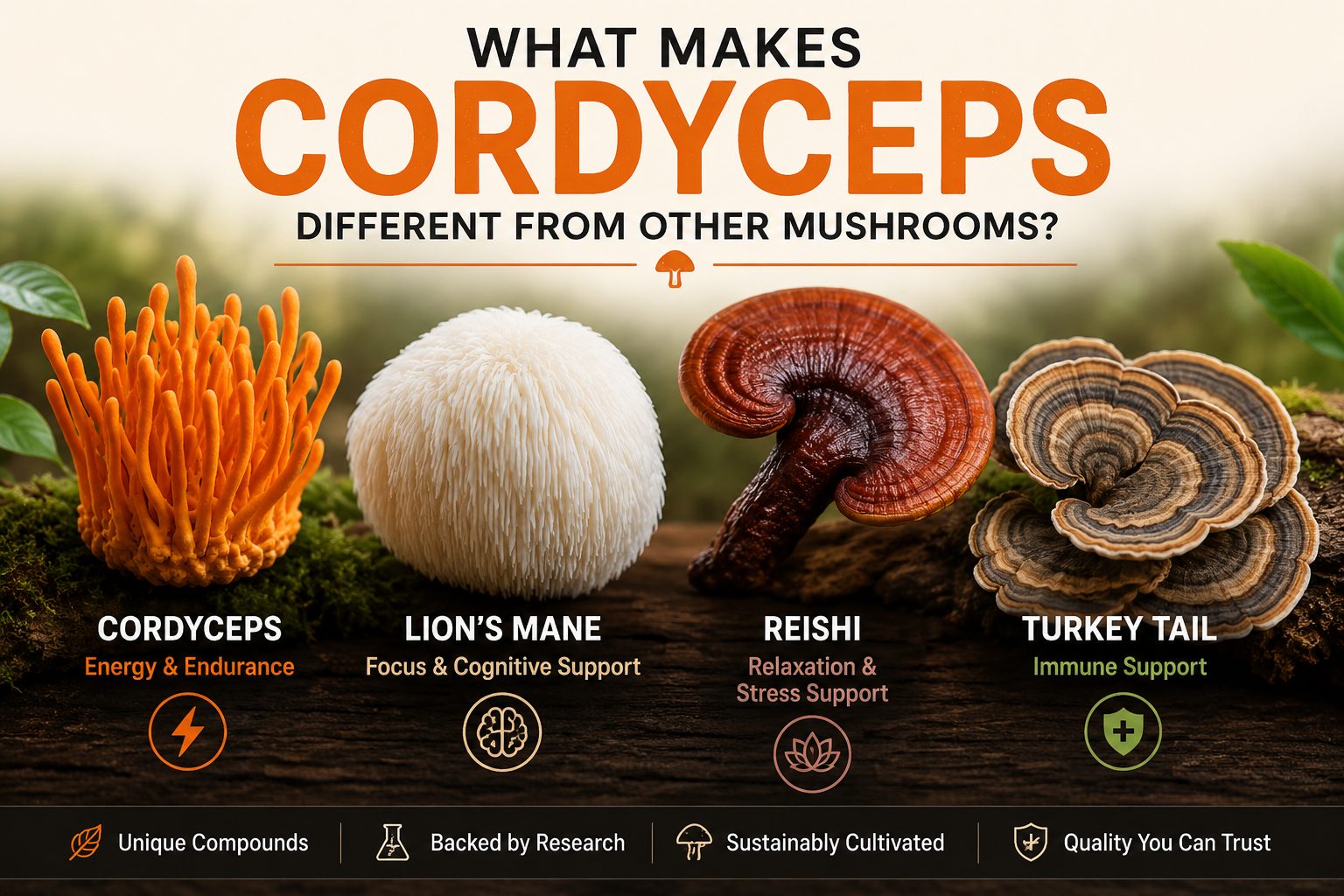
Cordyceps militaris differs from many familiar mushroom species in its appearance, biology, cultivation, and naturally occurring compounds. It produces distinctive orange fruiting bodies and can be cultivated indoors under controlled conditions.
Researchers continue to study compounds found in Cordyceps, including cordycepin, beta-glucans, polysaccharides, and sterols.
What Makes Cordyceps Different From Other Mushrooms?
Mushroom species vary considerably in their appearance, growth habits, chemical composition, and cultivation requirements.
Cordyceps militaris is particularly distinctive because of its unusual biology, bright orange fruiting bodies, and ability to be cultivated under controlled indoor conditions.
For a broader introduction to mushroom species and terminology, see What Are Medicinal Mushrooms?
A Unique Mushroom
Many familiar mushrooms form caps, stems, shelves, or brackets.
Cordyceps militaris instead develops narrow, upright orange fruiting bodies.
In nature, many Cordyceps-related fungi have unusual relationships with insects and other organisms. Cultivated Cordyceps militaris, however, can be produced without relying on wild harvesting or insects.
Modern cultivation allows growers to control factors such as:
- Temperature
- Humidity
- Light
- Air exchange
- Growing medium
- Harvest timing
For more information about cultivation, see How Medicinal Mushrooms Are Grown.
Naturally Occurring Compounds
Cordyceps militaris contains several naturally occurring compounds that researchers continue to investigate, including:
- Cordycepin
- Beta-glucans
- Polysaccharides
- Ergosterol and related sterols
- Proteins and amino acids
The amount of these compounds can vary depending on the strain, cultivation conditions, harvest time, and processing method.
To learn more about one important group of mushroom compounds, see Beta-Glucans Explained.
How Is Cordyceps Different From Lion’s Mane?
Cordyceps militaris and Lion’s Mane (Hericium erinaceus) differ considerably in appearance and growth.
Cordyceps militaris develops slender orange fruiting bodies.
Lion’s Mane forms white, cascading structures covered in tooth-like spines.
The two species also contain different naturally occurring compounds and require different cultivation conditions.
How Is Cordyceps Different From Reishi?
Reishi mushrooms form dense, woody fruiting bodies that often develop a glossy surface.
Cordyceps militaris produces much smaller, slender orange fruiting bodies.
Their texture, appearance, growing requirements, chemical composition, and culinary preparation also differ.
How Is Cordyceps Different From Turkey Tail?
Turkey Tail (Trametes versicolor) grows as thin, layered, fan-shaped fruiting bodies, often displaying bands of different colours.
Cordyceps militaris grows as upright orange fruiting bodies.
Both mushrooms contain naturally occurring polysaccharides and beta-glucans, but their overall composition and physical characteristics differ.
Why Cordyceps militaris?
Cordyceps militaris has become an important cultivated Cordyceps species because it can be grown reliably under controlled indoor conditions.
Modern cultivation:
- Reduces reliance on wild harvesting
- Allows controlled growing conditions
- Makes batch production more consistent
- Produces visible fruiting bodies
- Allows growers to monitor cultivation and harvest conditions
Another Cordyceps-related species frequently mentioned in historical literature is Ophiocordyceps sinensis, formerly known as Cordyceps sinensis. It is biologically and commercially different from cultivated Cordyceps militaris.
Whole Fruiting Bodies, Powders, and Extracts
Cordyceps products may be available as:
- Whole dried fruiting bodies
- Ground mushroom powder
- Extracted preparations
These forms are not identical.
Whole dried fruiting bodies retain the physical mushroom material, while extracts use processing methods to concentrate selected components.
For a closer explanation, see Mushroom Extracts Explained.
How to Identify a Quality Cordyceps Product
When comparing Cordyceps products, useful information to look for includes:
- Clearly identified species
- Clear ingredient list
- Fruiting body or other mushroom material identified
- Country or region of production
- Batch or lot information
- Net weight
- Storage instructions
- Testing information when testing is claimed
Consumers should also distinguish Cordyceps militaris from products that use other Cordyceps-related species or materials.
For more information about evaluating mushroom products, see How to Choose High-Quality Cordyceps Mushrooms.
Culinary Use
Whole dried Cordyceps militaris can be used in teas, broths, soups, and other food preparations.
It can also be dried and milled into powder for use in recipes.
If you are looking for whole dried fruiting bodies, see our Dried Cordyceps militaris product page.
Frequently Asked Questions
Is Cordyceps a mushroom?
Cordyceps is a group of fungi. Cordyceps militaris produces visible fruiting bodies and is commonly cultivated commercially.
Is Cordyceps the same as Lion’s Mane?
No. Cordyceps militaris and Lion’s Mane are different fungal species with very different appearances, cultivation requirements, and naturally occurring compounds.
Is Cordyceps the same as Reishi?
No. Reishi and Cordyceps militaris are different species with different fruiting body structures, growing habits, and physical characteristics.
Is Cordyceps the same as Turkey Tail?
No. Turkey Tail forms thin, fan-shaped fruiting bodies, while Cordyceps militaris develops slender orange fruiting bodies.
Why is Cordyceps militaris commonly cultivated?
It can be produced under controlled indoor conditions, making it possible to grow consistent batches without relying on wild harvesting.
Final Thoughts
Cordyceps militaris stands apart from many other mushrooms because of its distinctive biology, appearance, cultivation requirements, and naturally occurring compounds.
Modern cultivation has made the species widely available for research, food preparation, and commercial production while reducing reliance on wild sources.